


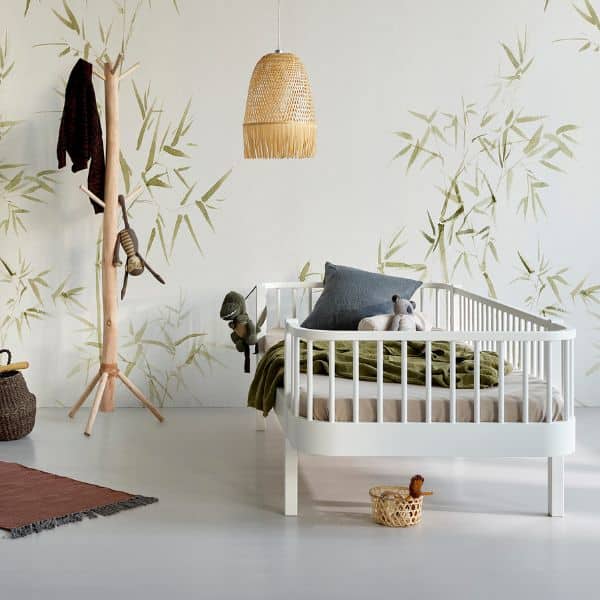
A toddler bed is a small, low bed designed for children transitioning out of a cot, typically from around 18 months to 4 years, while a junior bed is a slightly larger intermediate bed intended to bridge the gap between the toddler stage and a full single bed, usually for children from around 4 to 8 years. In practice, many Singapore families skip one or both of these intermediate stages entirely by investing in a modular bed system that starts low for toddlers and grows — without replacement — all the way through to the teenage years.
A toddler bed is a compact, low-profile bed frame designed specifically for young children making their first transition out of a cot. It typically fits a small mattress — often 70cm x 140cm in European sizing — and sits close to the floor to minimise fall risk. Guardrails on both sides prevent the child from rolling out during sleep. Most toddler beds have a maximum recommended age of around 4 years or a weight limit that signals when the child has outgrown it.
The toddler bed solves one problem well: the safety of the cot-to-bed transition for a very young child. What it does not solve is longevity. A dedicated toddler bed is typically outgrown within two to three years, requiring another purchase — and another room disruption — when the child moves to the next stage. For Singapore families managing compact HDB or condominium bedrooms, this cycle of purchasing and replacing small beds is both costly and impractical.
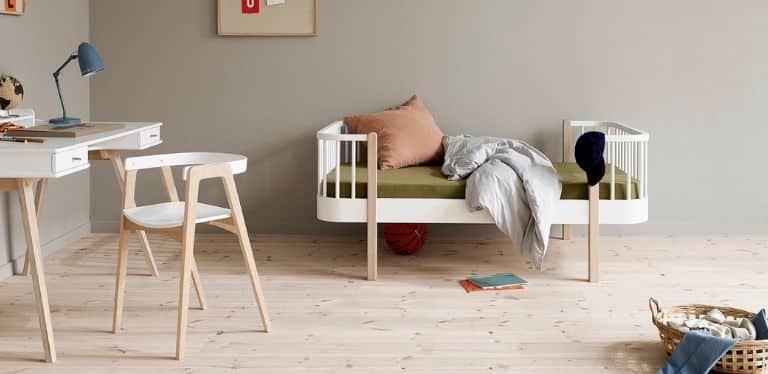
A junior bed occupies the stage between a toddler bed and a full single bed. It accommodates a larger mattress than a toddler bed — typically around 70cm x 160cm or 80cm x 160cm in European sizing — and suits children from approximately 4 to 8 years of age. It retains side rails for safety but provides more sleeping length as the child grows. Like the toddler bed, it is a transitional product: designed for a specific developmental window, and outgrown before long.
The junior bed exists because children grow faster than a toddler bed can accommodate, but may not yet be ready — physically or psychologically — for the full dimensions of a single bed. It is a reasonable interim solution when purchased as a standalone piece, but it creates the same replacement problem as the toddler bed: buy, use for a few years, replace.
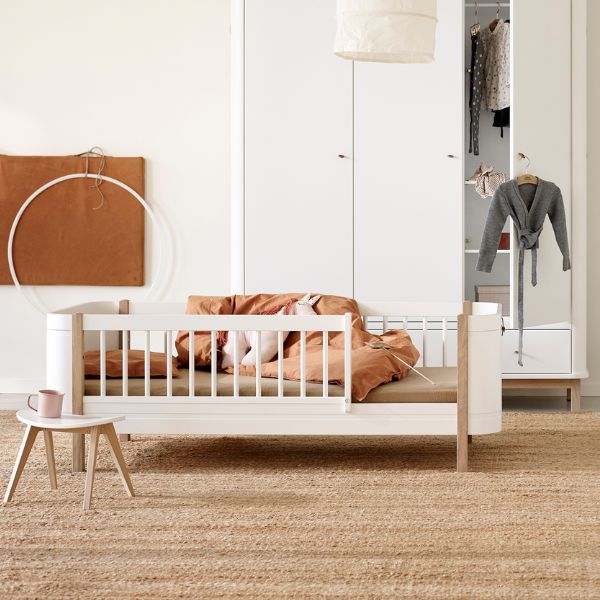
The differences come down to size, age range, and mattress dimensions:
For most Singapore families, buying a dedicated toddler bed followed by a junior bed followed by a single bed represents three separate purchases, three separate delivery and assembly exercises, three separate disposal challenges, and three rounds of adjustment for the child. Given the compact size of most Singapore children’s bedrooms — particularly in HDB three- and four-room flats — storing or disposing of outgrown beds is also a genuine practical problem.
The alternative that an increasing number of Singapore families choose is a modular bed system: a frame that begins in a low, toddler-safe configuration and converts through each subsequent stage — platform bed, mid-sleeper, loft, bunk — by adding components to the same core frame rather than replacing it. The upfront cost is higher than a toddler bed, but the total cost across a decade is almost always lower, and the room disruption of each transition is eliminated.
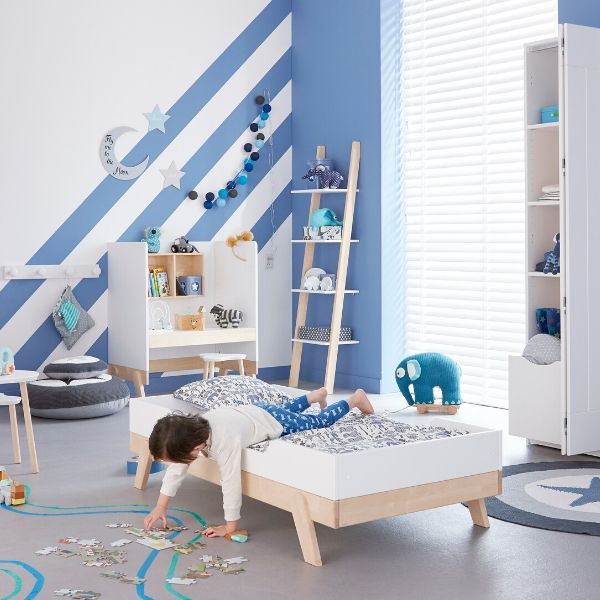
This is where Singapore parents frequently run into problems. The local market sells children’s beds in a range of sizes that do not always align with European sizing, and the terms “toddler bed,” “junior bed,” and “single bed” are used inconsistently between retailers.
Kühl Home’s Lifetime Kidsrooms beds use consistent European sizing throughout the system:
Both dimensions differ from the standard Singapore local single of 91cm x 190cm — 10cm shorter in length. This matters practically: a locally-purchased mattress will not fill a European-sized frame correctly, leaving a gap at the foot that affects both the appearance and the function of the bed. Always confirm the required mattress dimensions for your specific Lifetime Kidsrooms model and source a mattress cut to European dimensions.
The Lifetime Kidsrooms starting configuration — at 90cm x 200cm — is significantly larger than a dedicated toddler bed mattress and grows with the child through every subsequent configuration without a mattress change. This is one of the system’s most practical advantages: one mattress investment that remains appropriate from the toddler transition through to the mid-sleeper and loft stages.
Safety requirements differ between the lower and upper configurations of a modular system, and it helps to understand what standard applies at each stage:
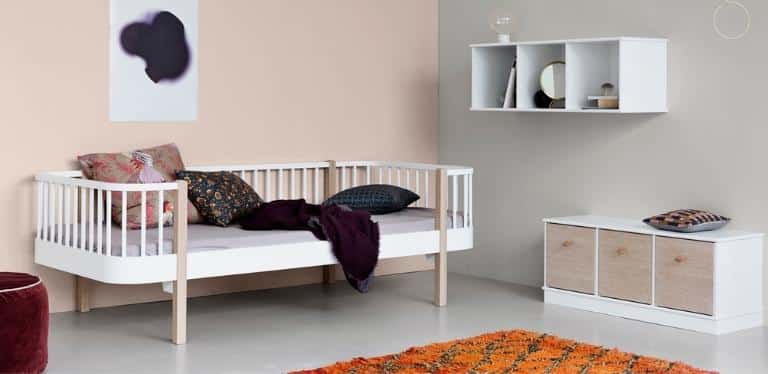
Singapore HDB bedrooms in three- and four-room flats typically measure between 8 and 11 square metres — a footprint that constrains furniture choices significantly. Key practical considerations for Singapore families choosing between a toddler bed, junior bed, or modular system include:
Kühl Home carries Lifetime Kidsrooms and Oliver Furniture — both Danish brands made in Denmark from solid Scandinavian pine, TÜV certified, finished in non-toxic paint, and backed by a warranty of up to 15 years. Rather than selling toddler beds and junior beds as separate transitional products, Lifetime Kidsrooms offers a single modular system that covers every stage from the Montessori floor bed configuration through to loft, high-sleeper, and bunk — using the same core frame throughout.
This means Singapore families who invest in Lifetime Kidsrooms at the toddler stage skip the junior bed purchase entirely, skip the single bed purchase, and arrive at a loft or bunk configuration for their older child or teenager without ever having replaced the original frame.
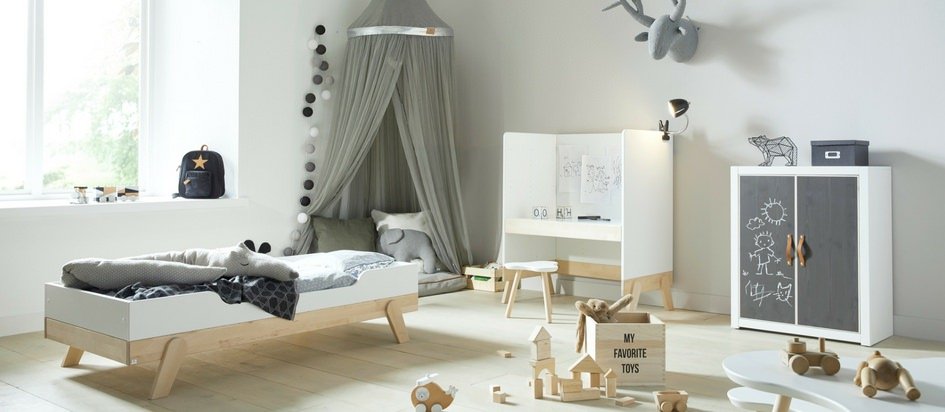
Visit the Kühl Home showroom at 100E Pasir Panjang Road #01-01 to see how the Lifetime Kidsrooms system covers every stage from toddler to teenager — and to understand in person why a modular system makes more sense than a sequence of transitional beds. No appointment needed. Open Monday and Wednesday to Saturday 10am to 6pm, Sunday and public holidays 12pm to 6pm. Message us on WhatsApp at +65 8401 1875 before visiting if you want to talk through your child’s age and room dimensions first.
Walk into any Singapore parenting forum or Facebook group today and the Montessori floor bed comes u...
The safest baby cots for Singapore nurseries carry independent TÜV certification, are built from sol...
Choosing a baby cot is one of the first and most consequential furniture decisions new parents make....
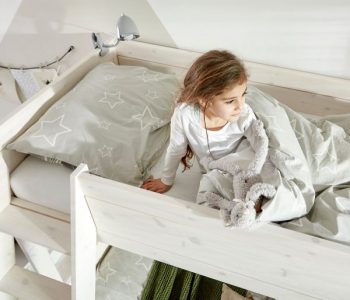
Choose a bunk bed when two children share a room and sleeping capacity is the priority. Choose a lof...
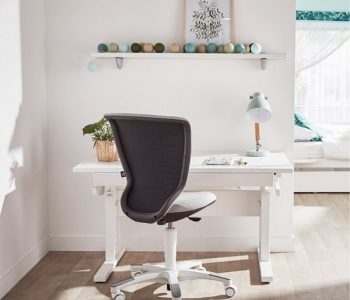
The shift towards home learning in Singapore has quietly changed what a child’s bedroom or study spa...
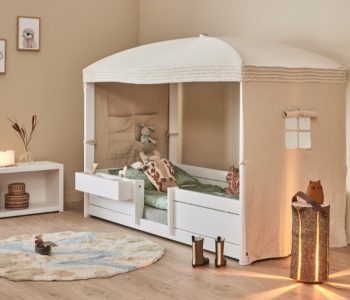
When buying a children's bed in Singapore, prioritise safety certification, material quality, mattre...
Please fill out the form below to receive our Catalogue.
There are no reviews yet. Be the first one to write one.